Still relying on Excel to manage your projects and data? Discover how Datalexing outperforms traditional Excel spreadsheets as a smart Work OS. Datalexing provides real-time team collaboration, workflow automation, interactive dashboards, and dynamic forms with full Arabic and AI support. While Excel remains a powerful calculation tool, Datalexing transforms your data into actionable decisions. Compare both tools and choose the best fit for your business needs, including project tracking, reporting, and data-driven productivity.
In 2025, businesses require tools that not only handle data efficiently but also adapt to modern workflows and team collaboration. Microsoft Excel, a long-standing favorite for data analysis, and Datalexing, a cutting-edge platform tailored for dynamic management, are two strong contenders in the data management landscape. Whether your focus is on precision in calculations or seamless team integration, understanding the strengths and limitations of these tools is essential to making the right choice.
In this article, we will compare both tools to provide insights that will help readers make an informed decision when choosing the right tool for their needs.
What is Datalexing?
Datalexing is AI-native Business Work OS designed to cater to a wide range of users, from individuals to teams across various industries. It simplifies project management, task organization, and workspace coordination with its intuitive interfaces and easy-to-use features.
This all-in-one tool makes it effortless to track tasks, set goals, manage data, and automate workflows. Whether you’re a beginner or an experienced professional, Datalexing’s simple yet powerful design ensures that everyone can get the most out of it.
With features like Kanban boards, real-time collaboration, advanced dashboards, and interlinked tables, Datalexing provides everything you need to stay organized and productive. It’s fully customizable and supports the Arabic language, with localized hosting to meet regional requirements, making it a perfect fit for users in Saudi Arabia and beyond.
Datalexing bridges simplicity and functionality, offering a tool that anyone can use to streamline their projects, enhance collaboration, and achieve their goals with ease.
Datalexing Features
Let’s look at some of Datalexing best project management features and how they help you manage your goals, tasks, and resources well.
Localization
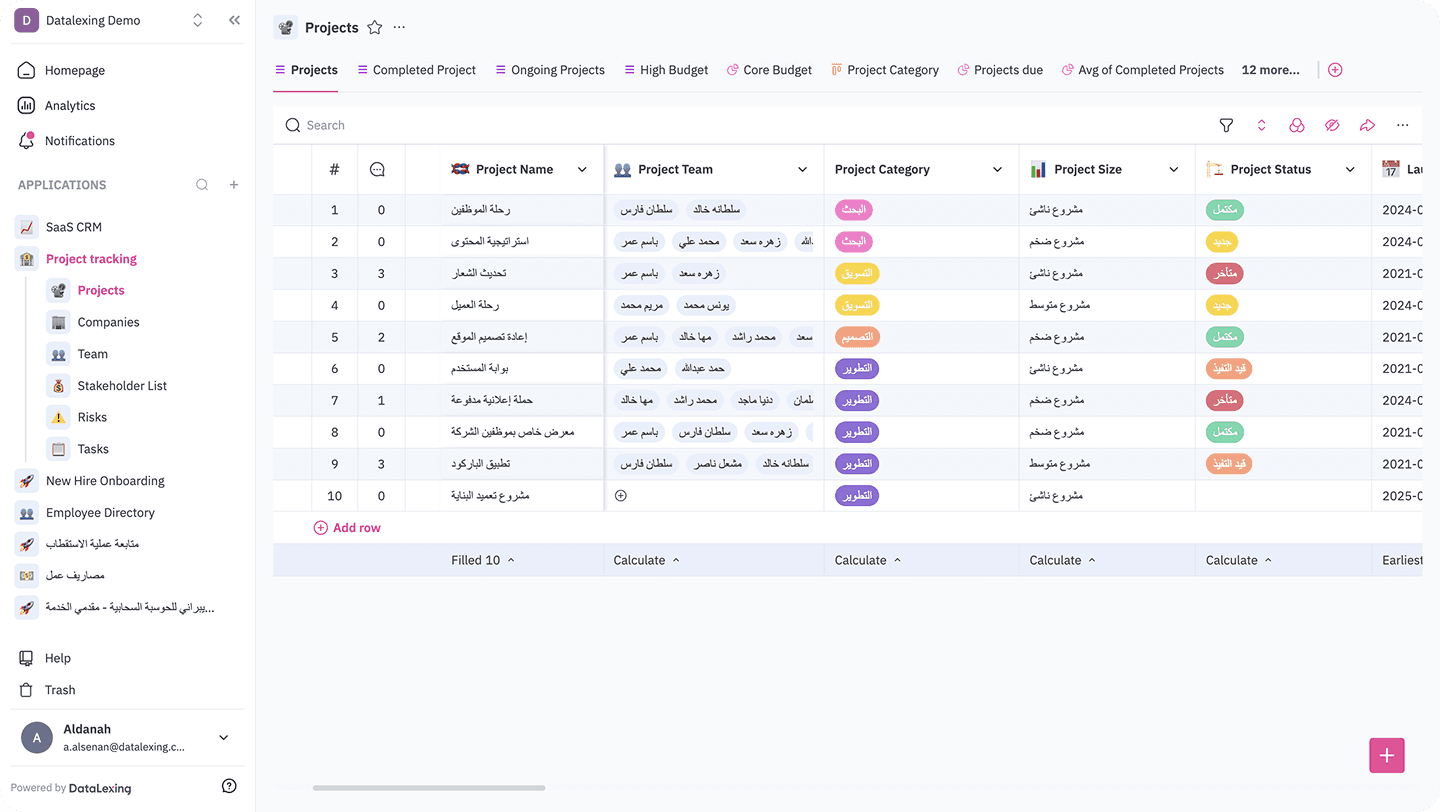
Datalexing excels in localization, offering full Arabic language support, right-to-left (RTL) interface direction, and local data hosting on servers within Saudi Arabia. This ensures compliance with local regulations and provides a seamless experience for users in the Middle East.
The platform’s deep understanding of the regional market extends beyond language and data hosting. It includes features tailored to local needs, such as support for local currencies and dual calendar systems. Datalexing’s commitment to localization ensures a natural and intuitive user experience for Arabic-speaking users.
One of Datalexing’s standout localization features is its local data hosting within Saudi Arabia. This approach complies with local cybersecurity requirements, such as those set by the National Cybersecurity Authority, ensuring the highest levels of data security and sovereignty. Organizations benefit from peace of mind, knowing their data remains within national borders, enhancing trust and data protection.
Datalexing’s localization capabilities make it a leading example of how productivity tools can be adapted to serve specific regional needs effectively, offering unmatched flexibility and compliance for businesses in the Middle East.
Permission
An advanced permission management system that allows users to define who can view or edit data, ensuring information security and confidentiality. Permissions are defined across multiple levels (workspace – application – tables – dashboard – pages). For workspaces, applications, and tables, permissions are categorized into the following levels:
Admin
Description:
Has full system permissions, including the ability to manage users, modify general settings, customize permissions, and create templates, tables, and everything that builders can do.Key Functions:
Full control over system settings.
Manage user roles and permissions.
Monitor the system and ensure compliance with security standards.
Create and customize tables and dashboards.
Builder
Description:
Has permission to modify table structures and permissions (workspace – application – table levels). Builders can create and edit applications fully.
They can create and manage applications, modify field names and types in tables, and perform all actions available to editors.
Editor
Description:
Editors can create and edit data in tables and manage tasks. They have extensive permissions but no full control over system settings and cannot create applications or workspaces.
They can perform all actions available to commenters.Key Functions:
Add, modify, and delete data.
Manage tasks within projects.
Interact with and update dashboards.
Commenter
Description: Can only read and comment on data. Has the ability to perform all actions available to viewers.
Viewer
Description:
Limited to viewing data without any editing capabilities. Ideal for employees or partners who need to access information without making changes.Key Functions:
View tables, projects, and dashboards.
Filter and search data within tables.
No Access
Cannot access any content.
Column Types
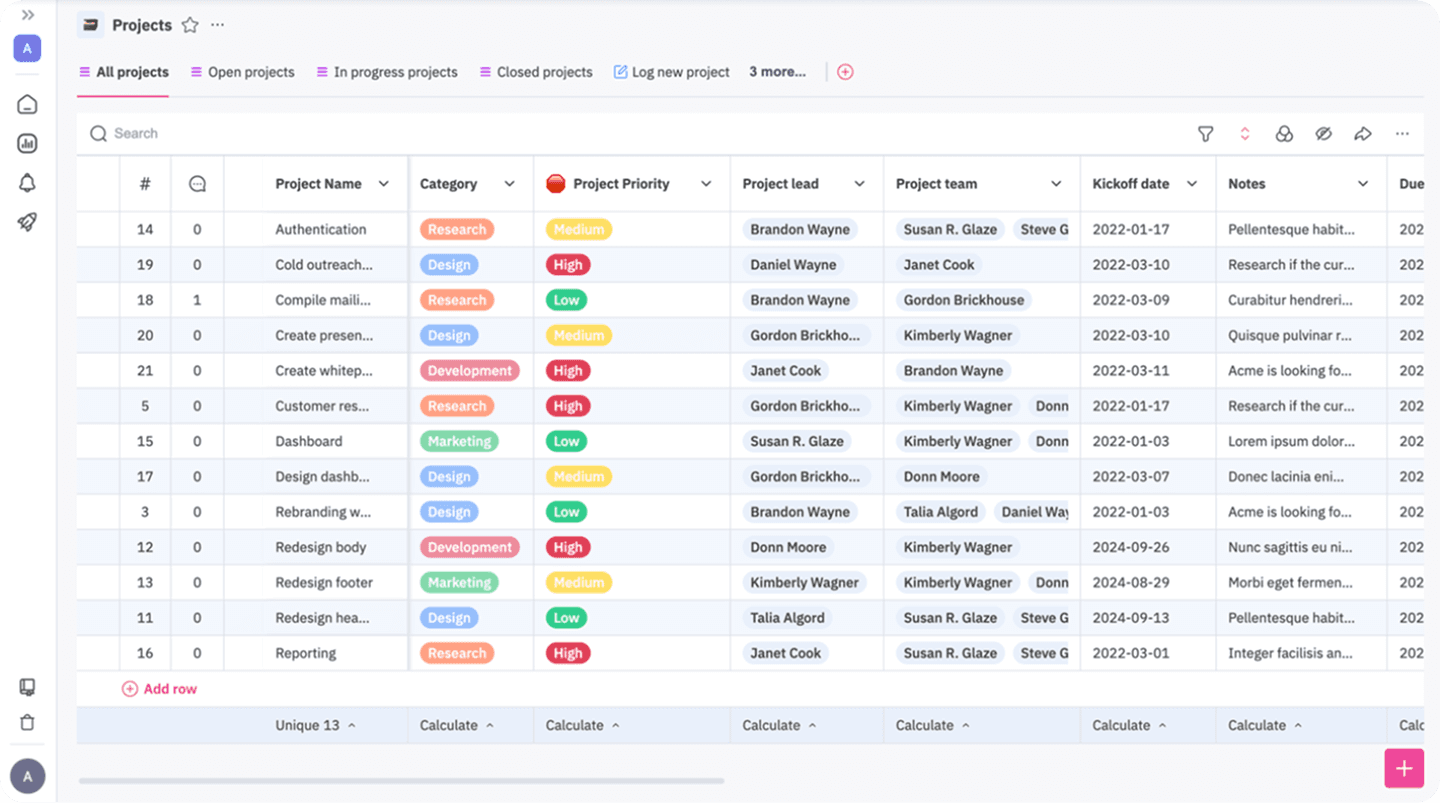
Datalexing sets a new standard in task and data management with its unmatched variety of column types. With more than 25 input types, the platform offers unparalleled flexibility to meet the needs of diverse teams and projects. The columns are designed as advanced tools capable of handling both simple and complex data through intuitive and user-friendly interfaces.
Key Column Types in Datalexing:
Text Columns: Ideal for capturing essential details and adding notes.
Formula Columns: Reduce calculation errors, handle complex operations, and create logical conditions directly within the platform.
Dropdown Menus: Simplify data entry with predefined options, ensuring consistency and accuracy.
Linked Data Tables: Allow integration of information across projects or tables, reducing redundancy and ensuring data consistency.
AI-Powered Columns: Support data inputs by automating processes like text translation between Arabic and English, summarizing content, checking for errors, rephrasing, simplifying, and analyzing texts.
Checkbox and Toggle Columns: Perfect for tracking task statuses or binary options.
Attachment Columns: Enable users to upload files, ensuring centralized and easily accessible resources.
Date Columns: Allow accurate date inputs with the ability to apply conditions.
Phone Number Columns: Ensure correct input of phone numbers, preventing invalid entries.
URL Columns: Validate correct web link formats and accept only valid entries.
Collaborator Columns: Help assign tasks to team members and specify responsibilities.
Last Updated Column: Displays the last time data was updated.
Creation Time Column: Shows the task creation time, enabling tracking of estimated completion time and applying conditional workflows.
Why Datalexing’s Columns Stand Out
The strength of Datalexing’s column system lies not only in its variety but also in its integration capabilities. Real-time updates and precise data sharing allow teams to collaborate efficiently. Whether creating comprehensive dashboards, managing complex tasks, or analyzing project performance, Datalexing’s column types deliver unmatched flexibility and power.
Datalexing Pricing
Datalexing offers tiered plans tailored to meet the needs of various organizations, ensuring robust project management capabilities and local hosting in Saudi Arabia. The price-to- feature ratio is competitive, making it a great choice for teams seeking a localized and secure solution.
Growths: 59 SAR/month per user Includes:
50,000 rows of data.
20 GB of storage.
Collaborative workspace for teams.
Local data hosting in Saudi Arabia.
Instant live reports without preparation.
Pro: 119 SAR/month per user (Minimum 5 users) Includes all features of Growths, plus:
500,000 rows of data.
100 GB of storage.
Up to 5,000 attachments per month.
50 webhooks.
Priority support and professional service level agreements.
Enterprise: Available only with an annual plan (Minimum 20 users) Includes all features of Pro, plus:
5,000,000 rows of data.
1 TB of storage.
Single Sign-On (SSO).
Audit records.
Dedicated servers and account manager All listed prices refer to the yearly billing.
What is Excel?
Microsoft Excel is a spreadsheet application widely used for organizing, analyzing, and visualizing data. It allows users to create grids of data, apply formulas for calculations, and generate charts to represent data visually. Excel is suitable for tasks ranging from simple data entry to complex financial modeling.
It includes features like pivot tables for summarizing data, conditional formatting to highlight specific patterns, and a wide range of built-in functions for statistical, logical, and mathematical operations. However, working with very large datasets can sometimes lead to performance issues, and collaboration on the same file may require external solutions like cloud integration.
Excel Features
Localization
Features: Excel supports multiple languages and regional formats, including currencies, dates, and number formatting specific to various locales. Users can switch between languages and apply formatting that aligns with local standards.
Limitations: While Excel supports right-to-left (RTL) languages like Arabic, its interface may not always handle these languages seamlessly, especially when mixing RTL and LTR text in the same document.
Permissions
Features: Excel allows users to set file-level permissions, such as read-only access or editing rights, when shared via OneDrive or SharePoint. Password protection can also restrict access to the file entirely.
Limitations: Excel lacks granular permissions for individual sheets or specific cells. Collaborative editing is limited without using cloud-based integrations, which might introduce version control issues for offline users.
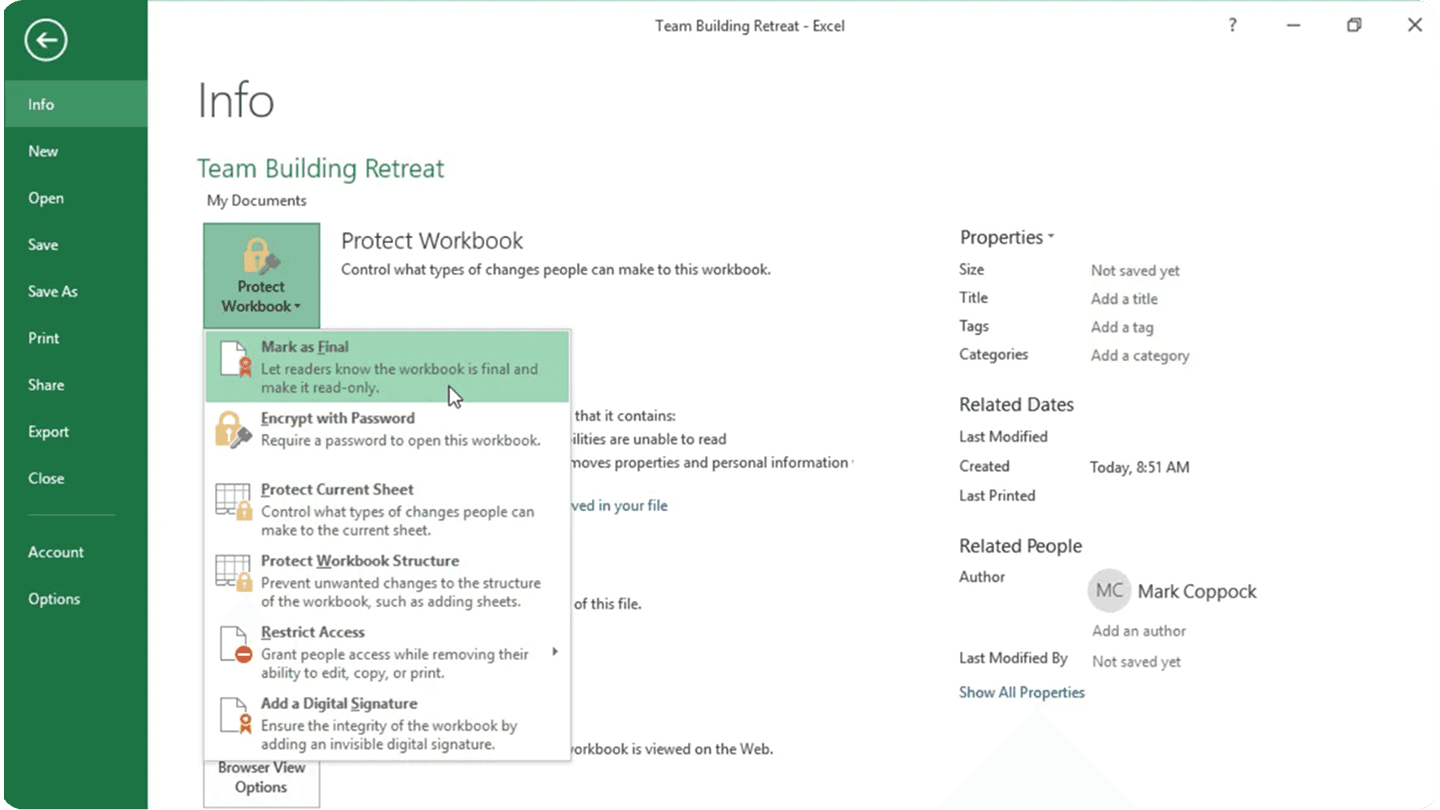
This image and its content are sourced from Excel. All rights reserved to their respective copyright holders.
Column Types
Features: Excel provides a wide range of column types, including text, numbers, dates, currencies, and formulas. Users can also apply data validation to restrict input types, ensuring data consistency.
Limitations: Columns in Excel are not inherently structured like database columns. There is no built-in functionality to enforce relationships between columns (e.g., foreign keys), making it less suitable for managing relational data.
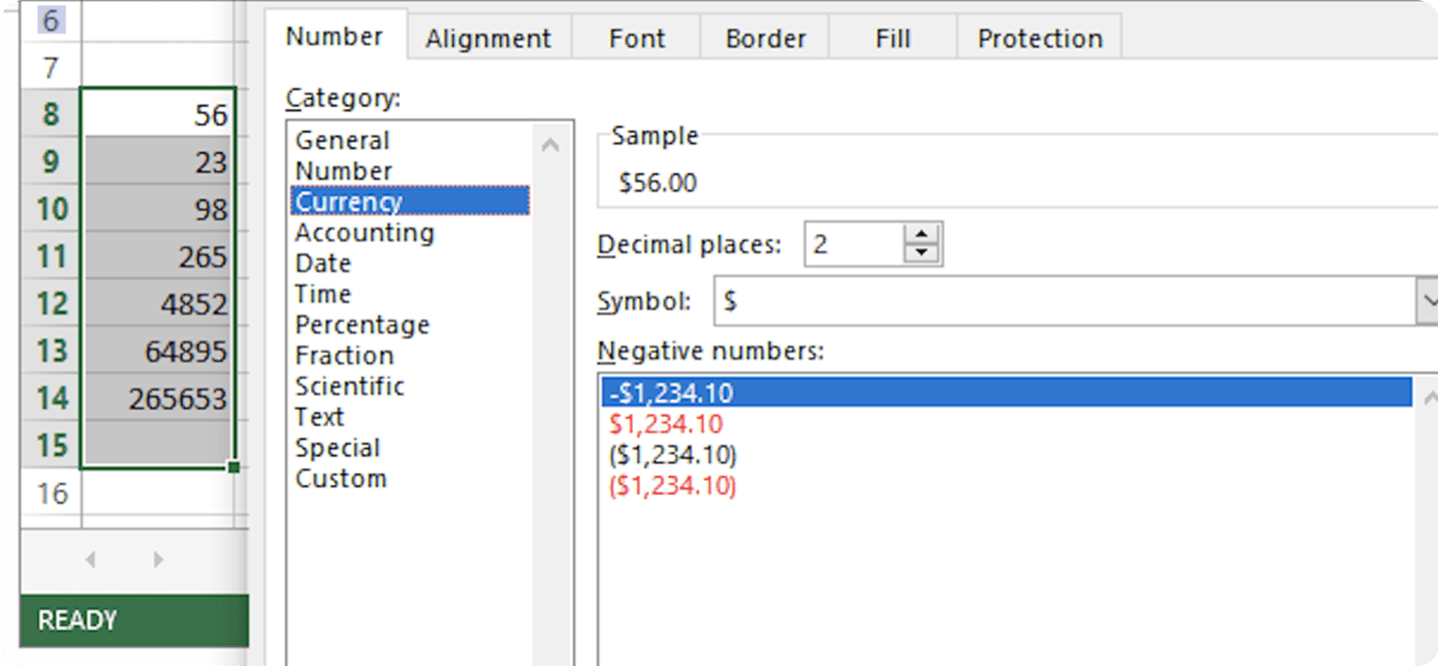
This image and its content are sourced from Excel. All rights reserved to their respective copyright holders.
Excel Pricing
Standalone Excel App:
Cost: $159.99 (one-time purchase for Excel only)
Features:
Excel desktop app without cloud collaboration features.
No updates or additional Office apps.
Enterprise Plans (Microsoft 365 Business):
Basic Plan: $6/user/month.
Standard Plan: $12.50/user/month.
Features:
Access to Excel along with all Office apps.
Advanced collaboration tools and business management apps.
Administrative and security features.
Excel Vs. Datalexing: A Features Comparison
Localization
Excel:
Excel supports a wide range of languages and regional formats, including currency, dates, and numbers. It also provides right-to-left (RTL) support for languages like Arabic. However, the user experience for RTL languages can sometimes be inconsistent, especially when mixing left-to-right (LTR) and RTL text.Datalexing:
Datalexing offers complete localization, including full support for the Arabic language with a seamless right-to-left (RTL) interface. Additionally, it provides local data hosting options, ensuring compliance with regional cybersecurity and data protection standards.
Winner: Datalexing, for its comprehensive localization and local hosting capabilities.
Permissions
Excel: Permissions in Excel are basic and file-based. Users can set read-only or editing permissions for a file when shared via cloud services like OneDrive or SharePoint. However, it lacks fine-grained control, such as assigning different permissions to individual sheets or specific cells.
Datalexing: Datalexing provides advanced, granular permission controls, allowing users to set access levels not just for tables but also for specific columns and rows. This ensures precise control over who can view, edit, or manage data within the platform.
Winner: Datalexing, for its more granular and customizable permission settings.
Column Types
Excel:
Excel supports a variety of column types such as text, numbers, dates, currencies, and formulas. It also allows data validation to restrict inputs. However, Excel lacks advanced data linking and structured column management, making it less suitable for relational data management.Datalexing:
Datalexing excels in offering over 25 input types, including advanced options like linked tables, dropdown menus, conditional logic, and AI-powered fields. These column types enable dynamic and interconnected data management, making it ideal for complex workflows.
Winner: Datalexing, for its extensive and advanced column type options.
Excel Vs. Datalexing: Who Wins? Who Loses? You Decide
Excel:
is an excellent tool for basic data management, calculations, and spreadsheet functionalities. It works well for individual users or teams managing straightforward tasks with minimal customization needs. However, it lacks advanced collaboration features, as real-time teamwork requires external solutions like OneDrive, often leading to version control issues or data conflicts.Datalexing:
on the other hand, is tailored for modern teams managing dynamic workflows. It allows all team members to work together on the same project or data in real time, enhancing collaboration and reducing errors. It also offers advanced features such as linked data tables, formula-based calculations, and granular permissions. Its support for the Arabic language and local hosting makes it ideal for businesses in the Middle East.
Which one should you choose?
Choose Excel if your focus is on independent data manipulation or basic spreadsheet-based tasks.
Choose Datalexing if you need an advanced, localized platform with robust collaboration tools and comprehensive task management features.
Share